26/03/2026
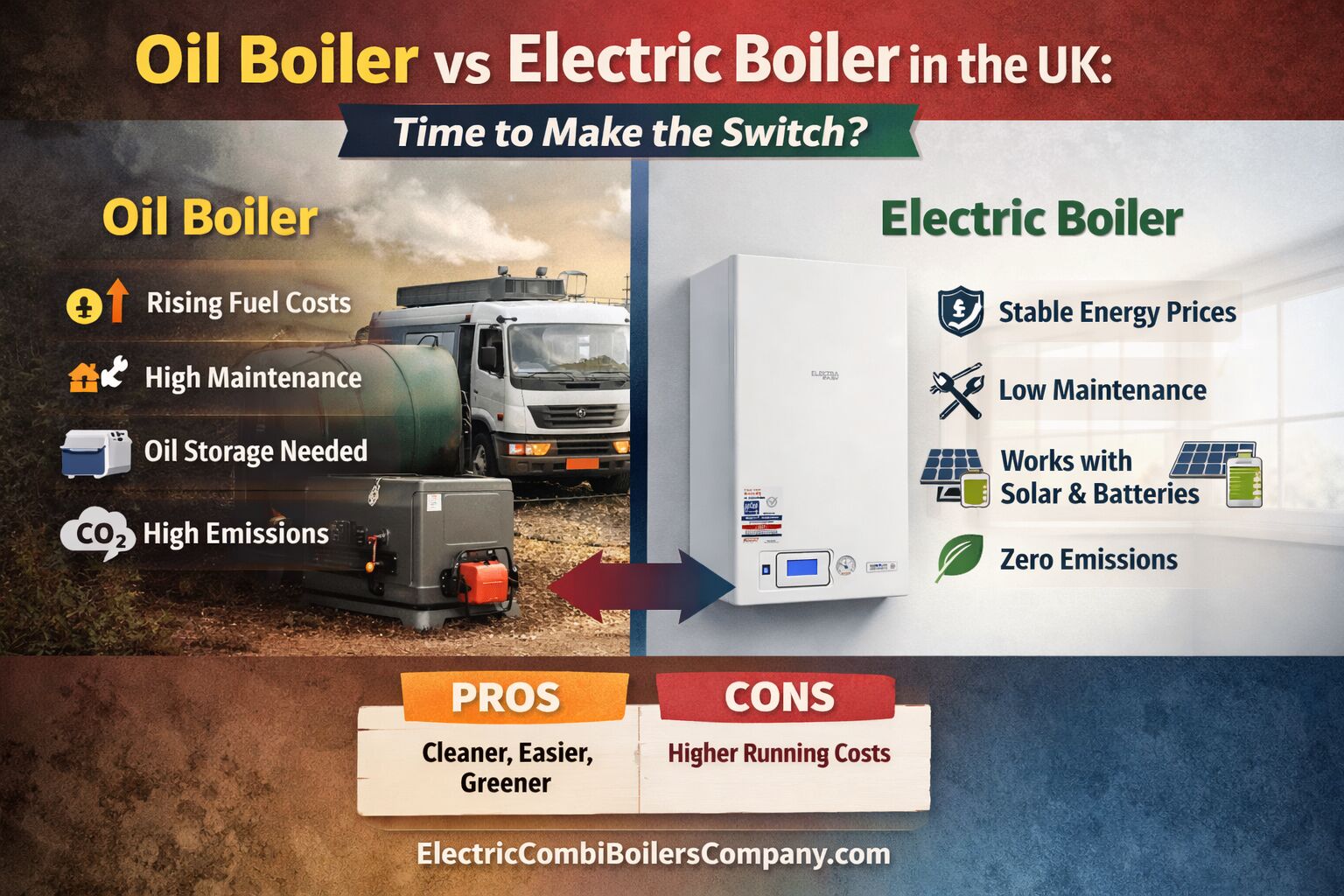
Oil Boiler vs Electric Boiler in the UK (2026): Should You Make the Switch?
For many UK homes—especially those off the gas grid—oil boilers have been the default heating solution for decades. But with rising oil prices, increasing maintenance demands, and a shift toward electrification, more homeowners are now reconsidering their options.
So, is it time to replace your oil boiler with an electric one?
Let’s break it down clearly.
1. The Current Reality of Oil Heating in the UK
Oil boilers are still used in around 1.5–1.7 million UK homes, mostly in rural areas. However, the landscape has changed significantly in recent years.
Key factors affecting oil users today:
- Highly volatile pricing
Heating oil is currently around £1.20–£1.30 per litre in many areas
Prices can change daily because they’re tied to global oil markets. - No price protection
Unlike gas and electricity, oil is not covered by the Ofgem price cap, meaning households are fully exposed to market spikes - Rising costs in 2026
Oil prices have surged 30%+ year-on-year, with recent spikes linked to geopolitical events - Typical annual cost
Most homes spend around £600–£1,200/year, but larger homes can easily exceed this - Bulk buying required
You must purchase oil in large quantities upfront (often £500–£1,000 per fill)
2. Electricity Costs (Context for Comparison)
Electricity is often seen as more expensive—but it’s more stable:
- Average electricity price: ~24–27p per kWh (2026 cap)
- Protected by the Ofgem price cap
- No need for bulk purchases
- Increasing integration with solar and battery systems
3. Oil Boiler vs Electric Boiler (Side-by-Side)
| Factor | Oil Boiler | Electric Boiler (e.g. ECBC ELEKTRA / GUIVAL) |
| Fuel cost stability | ❌ Highly volatile | ✅ Regulated (price cap) |
| Upfront fuel purchase | ❌ Yes (bulk oil tank) | ✅ No |
| Efficiency | ~85–90% | ~99% at point of use |
| Maintenance | ❌ Annual servicing + tank | ✅ Minimal servicing |
| Installation complexity | ❌ Flue, tank, fuel lines | ✅ Compact, simple |
| Carbon emissions | ❌ High | ✅ Zero at point of use |
| Noise | ❌ Audible burner | ✅ Silent |
| Space required | ❌ Tank + boiler | ✅ Wall-mounted only |
| Compatibility with solar | ❌ Limited | ✅ Excellent |
| EPC impact | Moderate | Depends on system (improves with renewables) |
4. Pros of Replacing an Oil Boiler with an Electric Boiler
1. Simpler, cleaner installation
Electric boilers (like ECBC’s ELEKTRA SMART or GUIVAL range) are:
- Compact
- Wall-mounted
- No flue, no tank, no fuel storage
This makes them ideal for:
-
- Flats
- Renovations
- Holiday lets
- Properties where space matters
✅ 2. Much lower maintenance
Oil systems require:
- Annual servicing
- Tank inspections
- Burner cleaning
- Fuel quality checks
Electric boilers:
- No combustion
- Fewer moving parts
- Significantly fewer failure points
✅ 3. Stable and predictable costs
Oil:
- Prices change daily
- No cap
- Influenced by global events
Electric:
- Price cap protection
- More predictable monthly costs
- Can be optimised with tariffs (e.g. off-peak)
✅ 4. Cleaner and future-proof
Electric boilers:
- No on-site emissions
- Align with UK decarbonisation targets
- Work seamlessly with:
- Solar PV
- Battery systems (e.g. BOLT concept)
✅ 5. No fuel storage risks
Oil tanks can:
- Leak
- Require space
- Need replacement
- Pose environmental risks
Electric systems eliminate this entirely.
5. Cons of Switching to an Electric Boiler
❌ 1. Higher unit cost of electricity
Electricity is still more expensive per kWh:
- Oil: ~8–10p/kWh
- Electricity: ~24–27p/kWh
👉 This is the main drawback
❌ 2. Electrical capacity requirements
Electric boilers (like 12kW systems):
- Require sufficient mains capacity (typically 60–100A supply)
- May need consumer unit upgrades
❌ 3. Running cost depends on usage
Electric boilers work best when:
- Property is well insulated
- Heat demand is controlled
- Smart usage or storage (e.g. batteries) is used
6. Where Electric Boilers Make More Sense
Switching from oil to electric is particularly strong in:
✔ Flats and apartments
- No space for oil tanks
- Lower heat demand
✔ Holiday lets / Airbnb properties
- Cleaner, safer, no fuel logistics
- Less maintenance between guests
✔ Modern or renovated homes
- Better insulation = lower running costs
✔ Properties with solar or batteries
- Electricity becomes significantly cheaper
7. Where Oil May Still Be Competitive
Oil boilers can still make sense if:
- You have a large, poorly insulated property
- You rely on very high heat demand
- You cannot upgrade electrical supply
- You bulk-buy oil strategically at low prices
8. Final Verdict: Is It Worth Switching?
Short answer:
- Yes — for simplicity, safety, and future-proofing
- It depends — for pure running cost alone


 Electric Combi Boilers Company
 contact@electriccombiboilers.uk
 Call 020 8998 2024