
CLICK TO CHAT

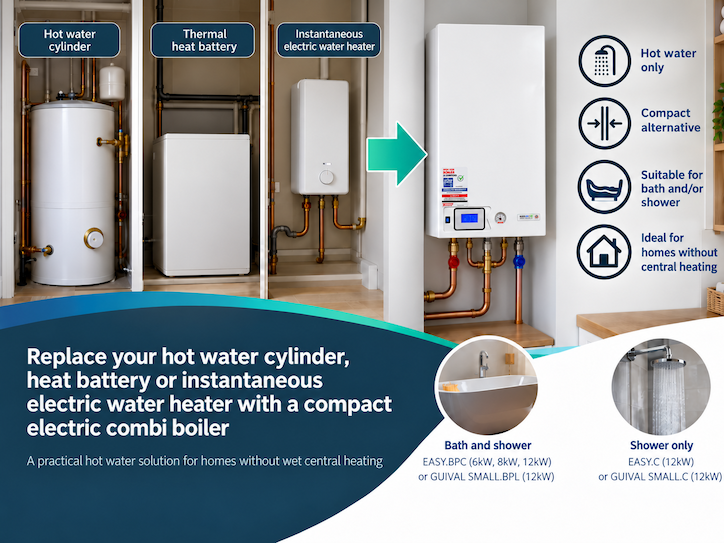
Looking to replace an old hot water cylinder, Sunamp heat battery or instantaneous electric water heater? There may be another option you haven’t considered: an electric combi boiler configured to provide hot water only.
When most people think of a combi boiler, they picture an appliance that supplies both central heating and domestic hot water. And that’s exactly what combi boilers are designed to do.
But what if you don’t need central heating?
Perhaps your property already has electric underfloor heating, electric radiators or another independent heating system. Maybe you live in a flat where space is limited, or your existing hot water cylinder is reaching the end of its service life.
At Electric Combi Boilers Company (ECBC), our compatible electric combi boilers can be installed to provide domestic hot water only, without connecting them to a central heating system.
This makes them an alternative worth considering when replacing certain traditional hot water storage and heating appliances.
Different properties use different methods to produce domestic hot water. Three common solutions are hot water cylinders, thermal heat batteries and instantaneous electric water heaters.
Each has its advantages, but there are also practical reasons why a homeowner or property manager might consider a replacement.
Hot water cylinders store a volume of heated water for use throughout the property.
Depending on their capacity, cylinders can occupy valuable cupboard or utility-room space. Once the stored hot water has been used, the cylinder needs time to reheat.
When replacing an ageing cylinder, homeowners may want a more compact appliance that can provide hot water without requiring a separate, full-sized storage cylinder.
Selected ECBC electric combi boilers incorporate a small internal hot water storage tank, combining hot water production and storage within one wall-mounted appliance.
This can be particularly useful where space is limited or where the existing cylinder is larger than the property’s actual hot water requirements.
Sunamp heat batteries use phase-change materials to store thermal energy, which can then be used to deliver domestic hot water.
These systems offer an alternative to conventional hot water cylinders, particularly in installations where compact thermal storage is desirable.
However, if an existing heat battery needs replacing, the homeowner may wish to explore a different approach to hot water production.
An ECBC electric combi boiler can offer an alternative, depending on the property’s hot water demand, available electrical supply and installation requirements.
Rather than storing heat in a phase-change material, the boiler uses electric heating elements to produce hot water. Some models also incorporate a small internal storage tank to support delivery.
Important: A heat battery and an electric combi boiler do not operate in the same way. Their hot water performance, storage characteristics and electricity consumption patterns differ, so any proposed replacement should be assessed against the property’s requirements.
Instantaneous electric water heaters heat water as it passes through the appliance, without storing a large volume of hot water.
They’re commonly used where space is limited or where hot water is required at particular outlets.
However, performance depends on the heater’s electrical rating, incoming water temperature and required flow rate.
For properties needing domestic hot water at multiple outlets, a suitable ECBC electric combi boiler may provide a practical alternative, subject to the total hot water demand and the model selected.
Our range includes boilers with built-in hot water storage as well as models designed for instantaneous hot water production.
Yes. Selected ECBC electric combi boilers can be configured to operate exclusively for domestic hot water, even when the property has no wet central heating system.
Ordinarily, an electric combi boiler has two separate hydraulic functions:
When a property does not require central heating, the primary circuit still needs to satisfy the boiler’s operational and pressure requirements.
This can be achieved by creating a correctly configured closed circuit between the boiler’s central heating flow and return connections.
This arrangement enables the appliance to maintain its required primary circuit conditions without supplying radiators or underfloor heating.
The domestic hot water side remains connected to the property’s cold mains supply and hot water distribution pipework.
The result is a combi boiler dedicated to providing hot water for everyday use.
The installation principle is straightforward for a competent heating engineer familiar with sealed electric boiler systems.
Instead of connecting the boiler’s heating flow and return to radiators or underfloor heating, the installer creates a closed hydraulic loop between the two connections.
This provides the boiler with a contained primary circuit.
The loop must be designed in accordance with the relevant boiler installation requirements, including suitable circulation, pressure maintenance and safety provisions.
A suitable filling arrangement is installed to allow the sealed boiler circuit to be filled and pressurised from the incoming cold water supply.
The filling arrangement must incorporate the appropriate backflow protection and isolation provisions required for the installation.
Once the correct system pressure has been achieved, the circuit is isolated from the mains supply in accordance with the manufacturer’s instructions and applicable water regulations.
ECBC boilers require a minimum primary circuit pressure of 0.8 bar for operation.
If the pressure falls below the minimum operating threshold, the boiler may prevent operation as a protective measure.
The installer must fill and commission the sealed circuit at the appropriate cold operating pressure, taking account of the appliance’s requirements.
For this hot-water-only configuration, ECBC recommends an incoming mains water pressure of approximately 1.5 to 2.0 bar.
Where the incoming pressure is above the recommended setting, ECBC advises installing an appropriate pressure-reducing valve (PRV) and setting it to 2.0 bar, subject to the appliance specification and site conditions.
A correctly specified PRV helps regulate the incoming cold water pressure and protects downstream components from excessive supply pressure.
The sealed primary boiler circuit must still have its own correctly configured pressure-control and safety arrangements.
The installer connects the cold mains water supply to the boiler’s domestic cold water inlet and the domestic hot water outlet to the property’s hot water pipework.
Once the electrical supply, hydraulic connections and required safety checks are complete, the appliance can be commissioned for hot-water-only operation.
This configuration must be assessed, installed and commissioned by appropriately competent professionals and confirmed as suitable for the selected boiler model.
The correct boiler depends on how hot water is used within the property, particularly whether you have a bath, shower or both.
For properties where hot water is needed for both bathing and showering, ECBC offers models with integrated hot water storage.
ELEKTRA EASY.BPC
Available in:
The EASY.BPC range combines electric hot water production with built-in storage, providing options for different electrical supplies and domestic hot water requirements.
The selected output should reflect the property’s electrical capacity, desired flow rate and typical usage.
GUIVAL SMALL.BPL 12kW
The GUIVAL SMALL.BPL is another option for properties requiring hot water for both a bath and shower.
Its wall-mounted format and integrated hot water storage make it worth considering for apartments, flats and other properties where installation space is restricted.
For properties without a bath, ECBC offers instantaneous electric combi boilers designed for shower-focused applications.
ELEKTRA EASY.C 12kW
An electric combi boiler designed to provide instantaneous domestic hot water, suitable for properties where the available hot water delivery matches the shower and outlet requirements.
GUIVAL SMALL.C 12kW
A compact instantaneous electric combi boiler suitable for shower-only properties.
The GUIVAL SMALL.C is designed primarily for one hot water outlet at a time, so simultaneous use and flow requirements must be assessed before selection.
| ECBC model | Electrical rating | Hot water application |
|---|---|---|
| ELEKTRA EASY.BPC | 6kW | Bath and shower, subject to demand |
| ELEKTRA EASY.BPC | 8kW | Bath and shower, subject to demand |
| ELEKTRA EASY.BPC | 12kW | Bath and shower |
| GUIVAL SMALL.BPL | 12kW | Bath and shower |
| ELEKTRA EASY.C | 12kW | Shower-focused properties |
| GUIVAL SMALL.C | 12kW | Shower-focused properties, generally one outlet at a time |
All these models are designed as electric combi boilers, but their suitability for hot-water-only installation should be confirmed against the relevant technical instructions.
Compact installation
A wall-mounted electric combi boiler can be a useful alternative to a conventional hot water cylinder, particularly where cupboard space is limited.
No need for a connected radiator system
With an approved hot-water-only configuration, the boiler can supply domestic hot water without being connected to a wet central heating installation.
Different hot water performance options
ECBC offers both instantaneous and internally stored hot water models, allowing the appliance to be matched to the property’s requirements.
A single appliance for hot water production
Where suitable, the boiler can replace an existing standalone hot water appliance, simplifying the overall installation arrangement.
Flexibility for different property types
A hot-water-only electric combi boiler may be suitable for apartments, flats, rental properties, studios, refurbishment projects and homes with independent heating systems.
A compact electric combi boiler is not automatically the correct replacement for every cylinder, heat battery or instantaneous water heater.
Before selecting a model, several factors must be considered.
Electrical supply: The boiler requires a suitable dedicated electrical installation. A 12kW appliance represents a substantial electrical load, so supply capacity, protective devices, cabling and any necessary electrical works must be assessed.
Hot water demand: The number of bathrooms, outlets, occupants and simultaneous usage patterns will influence which model is appropriate.
Flow rate and temperature: Hot water delivery depends on the selected boiler, incoming mains water temperature, pressure and required outlet temperature.
Existing installation: Replacing a cylinder or heat battery may require alterations to domestic pipework, isolation valves, safety devices and electrical connections.
Operating requirements: Boilers configured for hot-water-only operation still require the appropriate sealed primary circuit conditions, servicing access and safety measures.
An installer should also establish whether the property has any existing heating or renewable-energy equipment connected to the hot water system, as this may influence the most suitable replacement.
Not sure which model is suitable?
ECBC has developed a boiler selector tool to help customers identify an appropriate electric boiler based on their property’s requirements.
Whether you’re replacing a traditional hot water cylinder, a Sunamp heat battery or an instantaneous electric water heater, the first step is to understand how much hot water you actually need.
Use Our Electric Boiler Selector
You can also browse the full selection of available models, specifications and accessories.
Explore ECBC Electric Combi Boilers
Yes. Selected ECBC electric combi boilers can be configured for domestic hot water only, provided the installation satisfies the manufacturer’s requirements. A properly designed primary circuit is still necessary.
Not necessarily. For an approved hot-water-only installation, the central heating flow and return can be connected through an appropriately configured closed loop, eliminating the need to connect a radiator circuit.
ECBC specifies a minimum primary circuit operating pressure of 0.8 bar. The correct commissioning pressure must be established by the installer.
ECBC recommends approximately 1.5 to 2.0 bar for this configuration. Where necessary, a pressure-reducing valve can regulate the incoming water pressure to 2.0 bar.
Potentially, yes. However, the hot water delivery characteristics and electrical requirements are different. The proposed replacement must be assessed against existing usage patterns and the property’s installation conditions.
ECBC generally recommends the EASY.BPC or GUIVAL SMALL.BPL ranges for properties with baths. Instantaneous EASY.C and GUIVAL SMALL.C models are better suited to shower-focused installations. Bath filling performance on an instantaneous model may be limited by the available flow rate and temperature rise.
Not necessarily. An electric resistance boiler, electrically heated cylinder and electrically charged heat battery all convert electrical energy into heat efficiently. Their overall performance depends on storage losses, controls, demand, installation design and usage patterns.
The main reasons to choose a particular system may instead be size, hot water delivery, installation practicality and compatibility with the property.
Replacing an existing hot water system doesn’t always mean installing another cylinder or heat battery.
For properties that already have independent heating, an ECBC electric combi boiler configured for domestic hot water only may provide a compact alternative.
With suitable model selection, correctly designed hydraulic connections and the appropriate electrical supply, customers can benefit from an appliance that supplies the hot water they need without having to install a complete wet central heating system.
Explore the ECBC electric combi boiler range and find a model suited to your property.