Choosing an electric boiler isn’t simply about finding the cheapest model or buying the one with the highest kW rating. What really matters is how well the boiler performs, whether it suits your property and what happens if you need help after installation.
An electric boiler is a long-term investment in your home’s comfort. It needs to provide reliable central heating, deliver the hot water your household requires and operate safely within your property’s electrical capacity.
But not all electric boilers offer the same performance.
Two boilers with similar electrical ratings can deliver very different hot water experiences. One may be designed primarily for showers, while another incorporates internal hot water storage to help supply a bath.
Likewise, an attractive purchase price may become less appealing if spare parts are difficult to obtain or the supplier cannot provide reliable technical assistance.
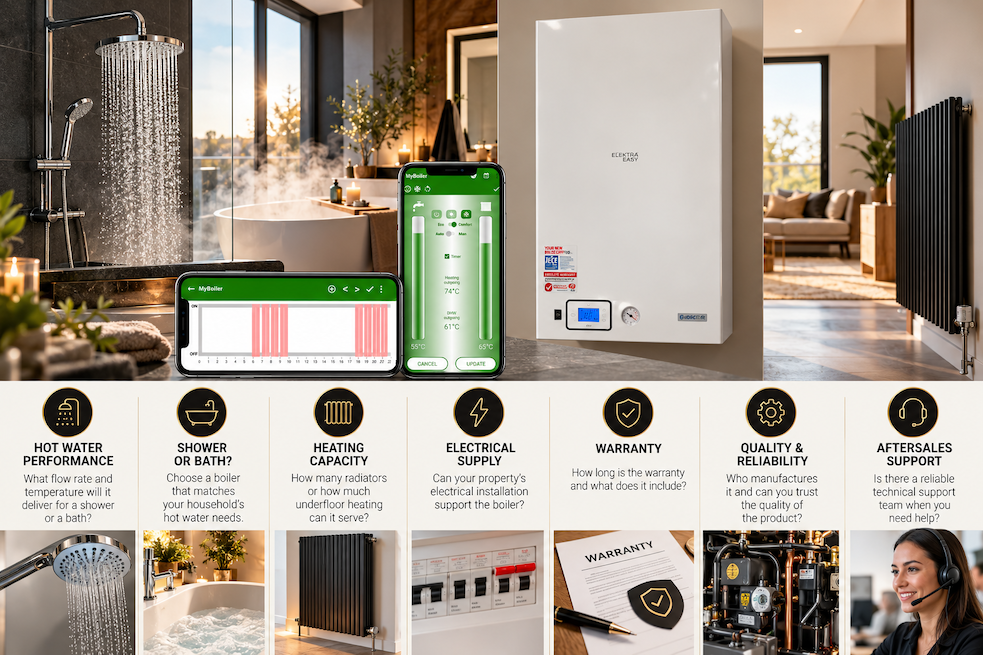
Before choosing an electric boiler, here are seven important questions worth asking.
This should be one of the first questions you ask, particularly when choosing an electric combi boiler.
A manufacturer’s advertised kW rating tells you the boiler’s heating power, but it does not tell you everything about its domestic hot water performance.
You need to know:
Hot water flow rate is normally measured in litres per minute (L/min).
However, a flow rate without a corresponding temperature is of limited value.
For example, a manufacturer may advertise a boiler capable of delivering 10 litres per minute. But is that water being delivered at 35°C, 40°C or 55°C?
That distinction makes a significant difference to everyday use.
The colder the incoming mains water, the more energy the boiler needs to raise it to the desired temperature.
For an instantaneous electric water heater, increasing the required temperature rise reduces the flow rate that can be maintained at a given power output.
Always ask the manufacturer to specify both the flow rate and the water temperature, along with the assumed incoming cold water temperature.
Let’s consider a 12kW electric boiler heating water instantaneously, without assistance from stored hot water.
If the incoming mains temperature is 10°C and you want water at 40°C, the required temperature rise is 30°C.
A 12kW electric heating element can theoretically deliver approximately 5.7 litres per minute at that temperature rise.
If the incoming water temperature drops to 5°C during winter, the available flow falls to approximately 4.9 litres per minute at the same 40°C outlet temperature.
These figures are theoretical and assume the full 12kW is available for water heating, without additional losses.
This is why the rated electrical output alone cannot tell you whether a particular boiler will provide the showering experience you expect.
The design of the boiler makes a substantial difference.
An instantaneous electric combi boiler heats water as it passes through the appliance.
A boiler with an integrated hot water cylinder or thermal store can draw on previously stored energy to supplement the electrical heating elements.
This can allow greater hot water delivery for a period of time, particularly when filling a bath or using a shower.
However, stored hot water is finite. Once that energy has been used, the system needs time to recover.
When comparing boilers, check whether the advertised flow rate is:
A higher advertised flow rate is only meaningful when you understand how it is achieved and how long it can be maintained.
Not every electric combi boiler is designed for the same domestic hot water requirements.
A compact instantaneous boiler may be entirely suitable for a flat with one shower.
But that doesn’t automatically make it the right choice for a family home with a bath.
For properties with a single shower and modest hot water demand, an instantaneous electric combi boiler may be a practical choice.
The key considerations are the shower’s required flow rate, the incoming mains water temperature and whether other outlets will be used at the same time.
Filling a bath requires a substantially greater volume of hot water.
An electric combi boiler with built-in hot water storage may offer a better experience because stored energy can supplement the instantaneous heating capacity.
ECBC offers models designed specifically for properties requiring hot water for both baths and showers, including the ELEKTRA SMART.BPC and GUIVAL SMALL.BPL ranges.
Choosing a boiler designed for your actual hot water requirements is more sensible than discovering after installation that filling your bath takes far longer than expected.
Hot water performance is only half the equation.
If your boiler also supplies central heating, it must have sufficient output to heat your property during colder weather.
Electric boilers are available in various power ratings, commonly including 6kW, 8kW and 12kW domestic models.
But how do you know which size you need?
You may see boilers advertised as suitable for a particular number of radiators.
For example, ECBC’s published specifications give indicative heating capacities of up to 14 radiators for selected 12kW models.
However, radiator count alone is not a reliable sizing method.
A small bedroom radiator may require considerably less heat than a large living-room radiator. Two homes with the same number of radiators may therefore have very different heating requirements.
A similar principle applies to wet underfloor heating.
Some ECBC electric boilers are advertised as suitable for approximately 100m² of underfloor heating, subject to the installation design.
Actual capacity depends on factors such as heat loss, floor construction, insulation and the required water temperature.
Before selecting a boiler, a competent heating professional should assess the property’s heat loss.
This considers factors including:
The boiler should be capable of meeting the calculated heating demand under the relevant design conditions.
A correctly sized boiler is more important than simply choosing the largest available model.
An electric boiler places a substantial demand on the property’s electrical installation.
Before purchasing one, you need to establish whether the available electrical supply is suitable.
For example, a 12kW single-phase boiler operating at 230V draws approximately 52 amperes at full output.
That load must be considered alongside the property’s other electrical demands, such as cooking appliances, electric showers, EV chargers and other high-power equipment.
An electrician should assess:
A higher-rated boiler may require electrical modifications that significantly increase the overall installation cost.
In some properties, a lower-rated boiler with an appropriate hot water storage arrangement may be more practical than a larger instantaneous appliance.
The right specification should consider both performance and electrical feasibility.
A warranty can provide valuable reassurance, but its duration is only one part of the picture.
A five-year warranty that includes accessible technical assistance, replacement parts and labour arrangements may offer better practical protection than a longer warranty with restrictive conditions and limited support.
Before buying, ask:
Who provides the warranty?
Is it the manufacturer, the UK distributor or the retailer?
What is included?
Does the warranty cover replacement components only, or does it also include engineer attendance, labour and call-out charges?
What conditions apply?
Some warranties require registration within a specific period, professional installation, approved system components and regular servicing.
What is excluded?
Failures caused by installation defects, poor water quality, unsuitable electrical supplies or neglected maintenance may fall outside warranty coverage.
ECBC offers extended warranty options on eligible electric boiler ranges.
Selected ELEKTRA models offer warranties of up to 10 years, while eligible GUIVAL models offer up to 5 years, subject to the relevant terms and conditions.
Requirements can include timely registration, suitable installation components and servicing every two years by ECBC or an authorised provider.
Customers should always review the warranty certificate for their chosen model to understand exactly what is covered.
The real value of a warranty isn’t just how many years it promises. It’s the protection and support you can actually access when something goes wrong.
An electric boiler may look simple from the outside, but its internal design and component quality influence its long-term performance and serviceability.
Before choosing a manufacturer, consider the following.
Look beyond the external casing.
The quality of the heating elements, heat exchangers, circulation components, sensors, electronic controls and hydraulic assemblies all matters.
For boilers with integrated hot water storage, the tank design, corrosion protection and maintenance requirements are also relevant.
Check whether the manufacturer provides applicable UK conformity documentation, product testing information and clear installation instructions.
Marketing claims about certification should be supported by relevant documentation for the specific model.
Reliability should be supported by evidence rather than advertising slogans.
Ask about service history, availability of replacement components and whether the supplier has practical experience supporting installed products over time.
Even a well-designed appliance may eventually need a component replaced.
Can the supplier obtain that component promptly?
Are replacement parts available within the UK?
Can a qualified engineer access the technical information needed to diagnose and repair the boiler?
These questions are especially important when purchasing a product expected to operate for many years.
Aftersales support is one of the most important factors when choosing an electric boiler, yet it’s often overlooked until something goes wrong.
A boiler is not an appliance you can simply leave unused while waiting indefinitely for assistance.
It provides essential heating and hot water.
If the boiler stops working during winter, the customer needs access to reliable information, appropriate troubleshooting and competent technical assistance.
Before purchasing, find out:
Aftersales support isn’t only about the homeowner.
Installers may occasionally require assistance during commissioning, configuration or fault diagnosis.
A supplier that can provide accurate technical guidance helps engineers resolve issues more efficiently and reduces the likelihood of unnecessary component replacements or repeat visits.
At Electric Combi Boilers Company, we recognise that customer support doesn’t end when the boiler is delivered.
Our UK-based technical and customer support operation assists customers and installers with installation guidance, troubleshooting, servicing and repair arrangements.
We provide access to technical documentation, a network of engineers and authorised service providers, and genuine replacement components for supported models.
Our service and call-out arrangements are published so customers can understand the available options and associated charges.
For us, supplying an electric boiler is only the beginning of the customer relationship.
The purchase price is naturally an important consideration, but it shouldn’t be the deciding factor without understanding the overall cost of ownership.
A cheaper boiler may seem attractive initially, but the financial picture can change when installation requirements, maintenance, repairs and ongoing support are considered.
Likewise, a more expensive boiler isn’t automatically better.
It should justify its price through suitable performance, construction quality, product features, warranty protection and accessible aftersales support.
When comparing electric boilers, consider the total package:
Performance + installation suitability + build quality + warranty + aftersales support.
That’s a more meaningful way to judge long-term value than comparing price tags or kW ratings alone.
No. A higher kW rating provides greater heating power, but it doesn’t necessarily mean better overall hot water performance or suitability. Storage capacity, hydraulic design, required water temperature and electrical supply limitations must also be considered.
It depends on your shower, bath and simultaneous hot water requirements. Always compare flow rates at the same temperature conditions and check whether the stated performance is continuous or supported by stored hot water.
Potentially, depending on the property’s calculated heat loss. A 12kW boiler may serve a number of radiators or a suitably designed underfloor heating system, but the building’s heating demand must be assessed before selection.
Instantaneous models may suit properties with modest hot water requirements, particularly shower-only installations. Models with integrated hot water storage can offer advantages where higher short-term demand is required, such as filling a bath.
Yes. Although electric boilers do not have gas combustion components, their electrical, hydraulic and water-heating components still require appropriate inspection and maintenance. ECBC specifies servicing every two years for eligible extended warranty coverage.
Not necessarily. The scope of coverage, exclusions, registration requirements, servicing conditions and availability of technical support can be just as important as the warranty duration.
Choosing the right electric boiler means understanding what your property actually needs.
Don’t rely solely on price, kW output or a manufacturer’s headline performance figures.
Ask how much hot water the boiler delivers, at what temperature, how many heating circuits or radiators it can support, whether your electrical supply is suitable and what support will be available after installation.
A well-chosen electric boiler should deliver suitable heating and hot water performance, with the reassurance of a reliable supplier and accessible ongoing support.
At ECBC, we want customers to choose a boiler that genuinely suits their property, not simply the most expensive or highest-powered model.
Not sure which electric boiler is right for your home?
Use Our Electric Boiler Selector
Or explore our full range of electric combi and system boilers:

