
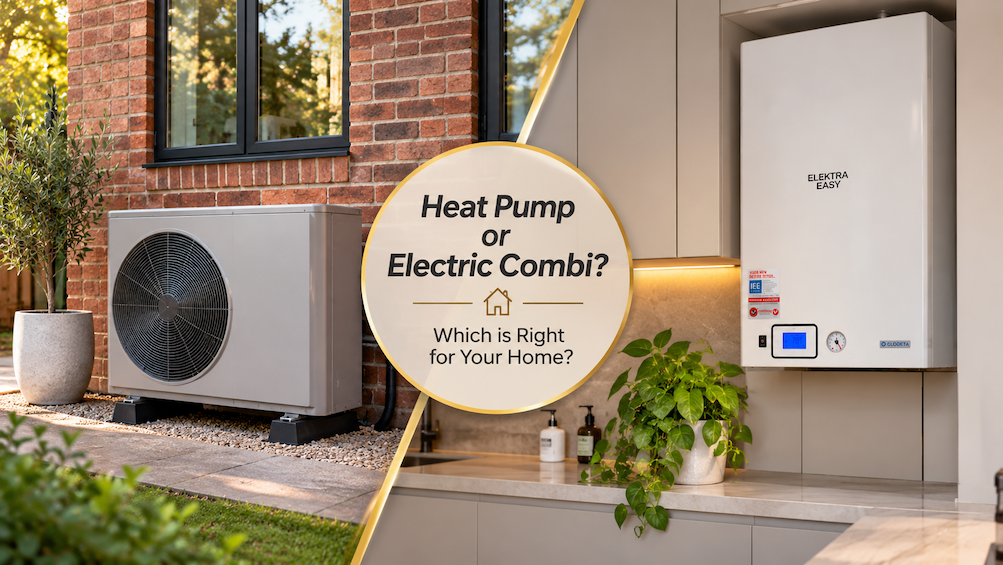
Heat pumps are having a moment. Energy suppliers publish live performance dashboards, the government offers a £7,500 grant, and every winter brings a fresh round of headlines, some glowing, some freezing.
Lost in the noise is the question that actually matters: what will work in your home, at a cost and level of disruption you are happy with?
The answer is not always the most efficient machine on paper. Here is how to decide.
Heat pumps are more efficient. Octopus Energy’s published fleet data shows its Cosy heat pumps delivering roughly 3.9 units of heat for every unit of electricity over a year. An electric boiler converts electricity to heat at close to 1:1.
If the lowest possible electricity use were the only test, the heat pump would win every time. We are not going to pretend otherwise.
For most households, though, it is not the only test.
No outdoor unit. A heat pump needs space outside, with clearance for airflow. Flats, terraces with no yard, leasehold properties and listed buildings can make that difficult, or subject to permission. An electric combi lives indoors, usually where your old boiler was.
No hot water cylinder. A typical air-source heat pump heats water into a storage cylinder, so you need room for one. An electric combi heats water on demand, much like the gas combi it often replaces. Your airing cupboard stays a cupboard.
Your radiators can usually stay. Heat pumps are most efficient at lower water temperatures, which often means larger radiators. As one heat pump specialist told the BBC, “if you don’t change your radiators your house will be cold.” An electric combi runs at conventional boiler temperatures, so radiators sized for a gas boiler generally do the job.
It heats like a boiler. Heat pumps work best running low and steady for long periods. That suits some households well. If you are out all day and want the house warm when you get home, a boiler’s quicker response may suit you better.
Lower upfront cost and less disruption. The government’s 2026 evaluation of its grant scheme puts a typical air-source heat pump installation at about £12,850 before grant. An electric combi installation typically costs [£X]. There is no outdoor unit to site, no cylinder to fit and usually no radiator overhaul. Most installs are completed in [X] days.
No gas, no flue, no fuss. There is no combustion, no flue and no carbon monoxide risk, and the boiler runs almost silently.
Not every heat pump story ends warmly.
The Telegraph reported on several households whose heat pumps struggled. One Nottingham homeowner found it took four hours to bring a room up to temperature on a mild day. When he switched back to his combi boiler, he said, “Within two hours, the temperature is the required level.” A Mid Wales homeowner arranged for an engineer to look at reinstating an oil boiler after two weeks of an underperforming installation.
An analysis of more than 61,000 UK homeowner forum posts by the Renewable Heating Hub found that complaints about poor installation rose around 24-fold in three years, and that undersized units unable to hold target temperatures in cold weather came up 177 times.
These are individual cases and forum discussions, not a measure of how often installations fail. Plenty of heat pump owners report being perfectly warm. The lesson is narrower and more useful: a heat pump is less forgiving of poor design. It has to be sized correctly, matched to the radiators and set up properly. When any of that is wrong, the house feels it first.
An electric combi still needs proper design: enough output, a suitable electrical supply and sensible radiators. But it asks less of the rest of your home.
An electric boiler uses more electricity than a well-performing heat pump to produce the same heat. Anyone who tells you otherwise is selling something other than the truth.
The difference in pounds depends on how much heat your home actually needs. In a flat, a smaller home or a well-insulated property, heat demand is lower and so is the gap. That makes the upfront saving, the space saving and the simpler installation count for more. In a large, draughty house with high heat demand, the heat pump’s efficiency carries more weight.
The heat pump grant matters here too. The Boiler Upgrade Scheme gives £7,500 towards a heat pump, or £9,000 for homes switching from oil or LPG between 21 July 2026 and 31 March 2027. When comparing, ask for the post-grant price and exactly what it includes: cylinder, radiators, electrical work and making good.
The government has confirmed that privately rented homes in England and Wales must reach the equivalent of EPC C by 1 October 2030, measured using new EPC metrics. Before choosing any heating system, ask an EPC assessor how it will affect your property’s rating.
Then think about your tenants. Familiar controls, instant hot water and a boiler that behaves like the one they grew up with mean fewer confused phone calls in January.
If an installer cannot answer all five clearly, keep looking. That applies to us too.
ECBC designed the UK’s first electric combi boiler and is the exclusive UK supplier of ELEKTRA and GUIVAL electric boilers, British-designed and Italian-manufactured. We install across mainland England and Wales.
Before confirming any boiler, we check suitability so there are no surprises later. Tell us about your property, your electrical supply and how you live, and we will tell you straight whether an electric combi is the right fit.
Call 02089 982 024 or [request a suitability check].
Figures checked 3 November 2026. Grant levels and supplier data can change.

