What Are Combi Boilers And How Do They Operate?

One of the most popular facilities worldwide is the central heating boiler. They help ensure that your home has access to hot water so that you can perform daily duties like cooking, cleaning, and maintaining your home’s temperature. But unfortunately, our dependence on them can frequently result in annoyance when they malfunction, and this annoyance can have an effect on us year-round.

It’s critical to comprehend the distinctions between each form of the boiler when deciding whether to replace or upgrade to a contemporary boiler so that you can select or suggest a unit that fulfils the demands of the building and lowers heating costs. Therefore, we’ve compiled this quick guide to help you learn more about combi boilers, outlining what they are, how they operate, and what advantages they have.

What Exactly Is A Combi Boiler?

The most common type of boiler in houses is a combi boiler, commonly referred to as a combination boiler. As the name implies, this boiler performs a “combination” of heating. With just one heating element, it can prepare both your hot water and electric central heating boiler.

Other boiler types require substantial extra components to deliver the same degree of warmth, which obviously requires more room to be utilised in your home. Whereas the combi boiler can typically be tucked away in a kitchen cabinet, which is one of the primary reasons it has become a widely sought-after form of the boiler. 

How Do Combination Boilers Operate?

The combi boiler receives cold water straight from the water supply system. The gas fuel is then used to create heat, which is then transmitted to the water via the water heater from the combustion chamber.

Your thermostat will sense a dip in temperature in your house, send a signal to your combi boiler, and the boiler will activate to produce the necessary heat.

When the target temperature is reached, the boiler will limit its heat output and keep things as they are, minimising energy waste and maintaining a comfortable temperature in your house.

When a hot tap, shower, or bath is used within the house, the diverter valve will send hot water to the outlets while it is in use. The diverter will return to central heating mode after the tap has been closed.

Benefits Of A Combination Boiler

Compared to other units, combi boilers have the following advantages:

  • A combi boiler combines a water heater and central heating into a single unit without needing a hot water storage tank, making it a compact unit.
  • High water pressure – Combi boilers are renowned for providing better hot water requirements than other units, providing a superb showering experience without needing to install a pump.
  • Quick hot water – Due to the combination boiler’s ability to heat water instantly, the owner will always have an abundance of hot water.
  • Fast, simple, and reasonably priced combi boiler installation– Combi boilers are often the easiest to install because they don’t need a separate tank.
  • Fuel efficiency rating – Since water is heated immediately rather than being kept separately, energy is only used when hot water is required. As a result, the owner’s energy costs are decreased!

Running Cost of the Electric Boiler Explained

Grasping the running costs of an electric boiler can be as tricky as planning a budget-friendly holiday. It’s not just about looking at the big picture; you have to zoom in on the details to truly understand where your money goes each month. At Electric Combi Boilers Company, we strip away the complexity to deliver straightforward, easy-to-understand information that helps you manage your heating expenses more effectively.

An electric boiler’s efficiency and cost-effectiveness hinge on various factors, including its size, the insulation of your home, your family’s heating needs, your local climate and the big factor being the electricity tariff.

Central Heating:

Heating is of the same output for all 12kW EK.C, EK.BPL and EK.BPC boilers. The boiler is capable of heating up to 14-16 radiators.

Maximum spend in 1 hour is 12kW. (Running cost @ full capacity – £0.15p per kWh x 12kW = £1.80 per hour)

However, the boiler will not run flat out at 12kW on heating.

When you start the heating, the boiler will use 6kW to build up temperature, once the left-hand temperature on the boiler screen reached 30C, the pump will start the heating circulation.

When the temperature is close to and reached the set temperature on the boiler, it will start modulating from 12kW to 0kW.

On average the boiler will run at 2kW or 4kW per hour on heating. (Subject to heat loss factor & number of radiators)

(This depends on various factors like, number of radiators, insulation at the property, heat loss, programmed room thermostat, others)

Therefore, the running cost per hour will be around £0.30p – £0.60p per hour. (Heating) (Unit rate @ 0.15p per kWh)

*Please note: The unit rate of electricity for the study is an example. Kindly check with your energy supplier to find out your tarrif.

Hot water:

The difference in the performance is on the hot water side between EK.C and EK.BPL or EK.BPC boilers.

The only difference between the Elektra C and Elektra BPL or BPC model is the in-built tank (Elektra BPL or BPC only).

Elektra BPL or BPC holds 37.5 Litres in the tank at 65C maximum. This boiler runs in 2 modes on the hot water side: Eco or Comfort.

Eco mode: The boiler uses 2kW to heat the tank water and once the tank water is cold you will have to wait for the water to heat up, which will take 30-45 minutes to reach 65C. The tank water will run for 6-8 minutes shower.

Comfort mode: The boiler uses 2kW to heat the tank and 12kW during the use of hot water. This mode gives you continuous running of hot water.

Elektra C has no storage tank on the hot water side and gives you instantaneous hot water at 45C-55C. The boiler runs at 12kW when the hot water is in use.

Heating & Hot water efficiency:
Elektra by Fiamma is the first and only boiler in the UK & Europe with A rating for both heating & hot water.

How Much Electricity Does an Electric Combi Boiler Use?

The amount of electricity your boiler consumes hinges on several factors, such as size, heating requirements, and insulation. An average electric combi boiler typically uses about 2-6 kilowatts per hour to heat a medium-sized home. This translates to roughly 24-72 kilowatt-hours for a 12-hour day of heating during the colder months.

Let’s break it down with some math. With the average cost of electricity per kilowatt-hour at around 30 pence, operating your boiler could cost about £7.20-£21.60 for a full day. Over a month, assuming daily use, the cost sits around £216-£648. However, this is a high-end estimate, and your costs might be lower with efficient usage and good home insulation.

What is the Optimal Temperature Setting for an Electric Boiler to Maximise Energy Efficiency?

Finding the sweet spot for your boiler’s temperature setting is a bit like finding the perfect temperature for your morning cuppa – not too hot, not too cold, just right. Setting your boiler around 65 to 70 degrees Celsius is generally considered efficient for both your comfort and your wallet.

Why this range? Well setting the temperature higher than necessary can lead to unnecessary energy consumption, much like boiling a full kettle for a single tea bag. On the flip side, setting it too low might not meet your heating needs, prompting your system to work harder and use more energy, which is as counterproductive as a chocolate teapot.

Conclusion

Navigating the costs and settings of your electric combi boiler doesn’t have to be a complex affair. It’s about making informed decisions, understanding your household needs, and adjusting settings to suit your lifestyle. Think of your electric boiler as a team player in your home’s energy squad, working efficiently behind the scenes to keep you cosy.

Remember, a stitch in time saves nine. Regular maintenance and sensible settings can significantly reduce your electric bills and environmental impact. So, while the initial figures might seem a bit steep, the long-term savings and benefits of an electric boiler are well worth considering. Keep these tips in mind, and your boiler will not just be a heating element but a wise investment in your sustainable living strategy.

Is it time to switch to an electric boiler?

 

Gas is becoming increasingly augmented; the USA reports gas prices as elevated as $75 a barrel.  Meanwhile, here in the UK, a winter blackout is likely to occur if the situation is not resolved.  The wholesale price of gas has surged by 250% since August.[1]

Ofgem (the Office of Gas and Electricity Markets) has stated consumers can expect an average price surge of £135 this winter per household. [2]

The gas shortage has resulted in a reduction of carbon dioxide, causing chaos in supermarkets: CO2 is used to stun animals prior to slaughter and as s life extending agent in food packages; we could see shortages of poultry on shelves as soon as next week. 

So why switch to an electric boiler?

With the UK committed to reducing emissions to zero by 2050, the government needs to take drastic action. And it is highly likely that a key part of their plans will be a gas boiler ban, starting from as early as 2025.

Electric boilers are clever little things: they are very simple, don’t need a plethora of space and can be placed almost anywhere in your property because they don’t need a flue or a gas pipe to run them.  Very little heat is lost in heating the water, so electric boilers are almost 100% efficient. Therefore, the cost of installation is much less than that of a gas boiler.

Our boilers are A rated for hot water and over 99% efficient.[3]  This being the case, eventually it will end up costing similar to run than gas.  (Subject to heat loss factor and heating controls)

The future is moving towards electric; NOW is the time to switch.


[1] https://www.bloomberg.com/news/articles/2021-09-04/global-gas-price-surge-threatens-to-dent-the-economic-recovery cited 23rd September 2021

[2] https://www.ofgem.gov.uk/ cited 23rd September 2021

[3] https://electriccombiboilerscompany.com/ cited 23rd September 2021 [*] Images: PA Images /SkyNEws

Is it difficult to swap or replace an existing Gas combi boiler with Electric combi boiler?

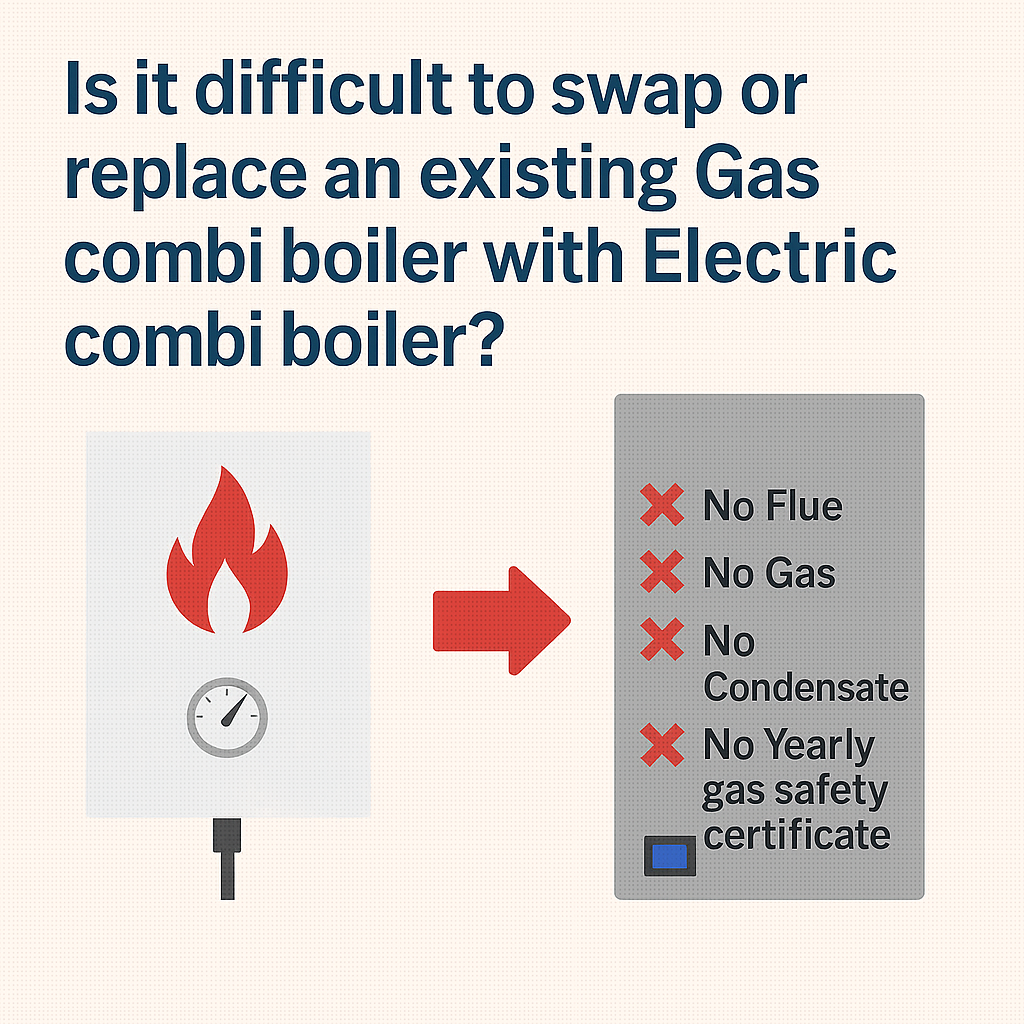
It is not at all difficult to replace your existing gas boiler with an electric boiler.

The plumbing of heating and hot water is the same and can be adapted/fitted to the new electric boiler.

Since there is no flue on the electric boiler, the location of the boiler can be the same or relocated within the property without any restriction.

There is no gas pipe required on an electric boiler which will save you money on yearly gas safety certification. If you remove the gas meter this will save you an overall costs incurred on yearly meter standing charges and carbon monoxide (CO) detectors.

There is no condensate with electric boilers because the appliance is 100% electric and does not have a flue.

Electric boilers for heating and hot water is the future and is a growing market for people who want to remove their gas boilers to have a cleaner safer alternative, such as our Elektra electric combi boiler.

Steps for Swapping a Gas Combi Boiler to an Electric Combi Boiler

Considering switching from a gas combi boiler to an electric one? Here’s how you can make the transition smoothly and efficiently.

Remove the Old Gas Boiler System

The first step is removing your existing gas boiler. This involves safely disconnecting the gas supply and carefully dismantling the unit. It’s crucial to follow safety protocols to avoid any hazards. Hiring a professional for this task is highly recommended to ensure everything goes smoothly.

Installing a New Electric Boiler

Once the old boiler is out, the next step is installing your new electric combi boiler. Electric boilers are compact and usually require less space than gas boilers, making them easier to fit in smaller areas. Ensure the area is prepared for installation, with all necessary electrical connections in place.

Plumbing Connections

Connecting your new electric boiler to the existing plumbing is a critical step. This includes attaching the water inlet and outlet pipes correctly to ensure optimal operation. It’s essential to check for leaks and ensure that all fittings are secure to prevent any future issues.

Heating Controls

The final step in the installation process involves setting up the heating controls. This could mean syncing the boiler with your existing thermostat or installing a new one. Modern electric boilers often come with smart controls that allow you to manage your heating remotely.

Why Switch from Gas to Electric Boiler?

Making the switch from gas to electric boilers offers numerous benefits, from cost savings to enhanced safety. Here’s why you might consider it:

Energy Efficiency & Cost Savings through Modern Technology

Electric boilers are highly efficient as they convert almost all the energy they use into heat. They are generally more efficient than gas boilers with no heat loss from waste gases. This efficiency can translate into lower heating bills, making electric boilers an economically wise choice. (Subject to tariff)

Enhanced Safety and Risk Mitigation

Unlike gas boilers, electric boilers do not burn fuel to generate heat, which significantly reduces the risk of carbon monoxide poisoning and gas leaks. This makes them a safer alternative, providing peace of mind for homeowners.

Installation Flexibility

Electric boilers don’t require a flue or gas supply, which means they can be installed in various locations within a property. This flexibility can be particularly useful in properties without existing gas lines or those with space constraints.

No Fuel Storage

With electric boilers, there’s no need for on-site fuel storage. This eliminates the need for a storage tank and the associated maintenance and safety concerns, streamlining your home’s heating system.

Environmental Responsibility and Carbon Footprint Reduction

Electric boilers can be a more environmentally friendly option, especially if paired with renewable energy sources. They produce no emissions at the point of use, helping reduce your home’s carbon footprint and contributing to cleaner air.

Precision Control and Automated Heating Management

Today’s electric boilers have advanced technology for precise temperature control and heating distribution. Many models feature automated systems that adjust heating based on real-time needs, enhancing comfort and efficiency.

In conclusion, swapping your gas boiler for an electric one aligns with modern energy standards and offers numerous practical and safety advantages. Whether it’s for cost savings, environmental reasons, or the convenience of modern technology, transitioning to an electric boiler is a smart move for any homeowner.

Click here to browse our product range

Say hello to a new generation of combi boilers

In 2014 Electric Boilers Company welcomed an efficient alternative to replace your standard gas combi boiler. In this day and age one wonder’s why we are still dealing with the hassle gas boilers entail. The flue, the carbon monoxide, the condensate, having to call a plumber who is gas safe certified, having to replace numerous parts, diminishing efficiency … all these need not be a problem anymore.

Using electricity to fuel your boiler makes way for a much cleaner and smarter method of heating and providing hot water in your house. Our Elektra electric combi boilers work exactly like gas combi boilers, with an instant delivery of hot water. However, no gas is being burnt therefore there is no Carbon Monoxide (CO), no flue, no condensate, no need for a gas safe certificate and a yearly service is not required.

Our boilers have no flue and are completely silent, therefore these can be installed anywhere in the home that a 10mm cable is within reach of. They have much fewer parts, which means there is less to go wrong and therefore less to replace which in the long term saves you money on replacing parts. Elektra boilers can also be integrated with solar PV panels, which allow the user to be self sufficient in providing their own electricity. The boilers run on 12 kW and have the ability to modulate down in energy usage consequently saving the user money due to less running costs and 99.9% efficiency.

Electric boilers Company are taking the industry forward, to a more efficient and simple era of providing heating and hot water in your household. Heating your home does not have to be complicated, nor does it have to cost you an arm and a leg.