
CLICK TO CHAT

Managing an Airbnb, holiday home, short-term rental or HMO? With a smart electric boiler, you can control your property’s heating and hot water remotely, manage operating schedules and avoid unnecessary electricity consumption, even when you’re miles away.
Running a rental property involves more than maintaining bookings and welcoming guests. Heating and hot water are essential services, but they’re also significant contributors to a property’s electricity consumption.
For landlords and property managers whose electricity costs are included in the rental price, managing these services can be particularly challenging.
Guests might leave the heating running when they go out. A holiday property could remain heated unnecessarily between bookings. And when managing several properties, visiting each one simply to check or adjust a boiler is hardly a practical use of anyone’s time.
Fortunately, modern smart heating technology offers a more convenient way to manage these situations.
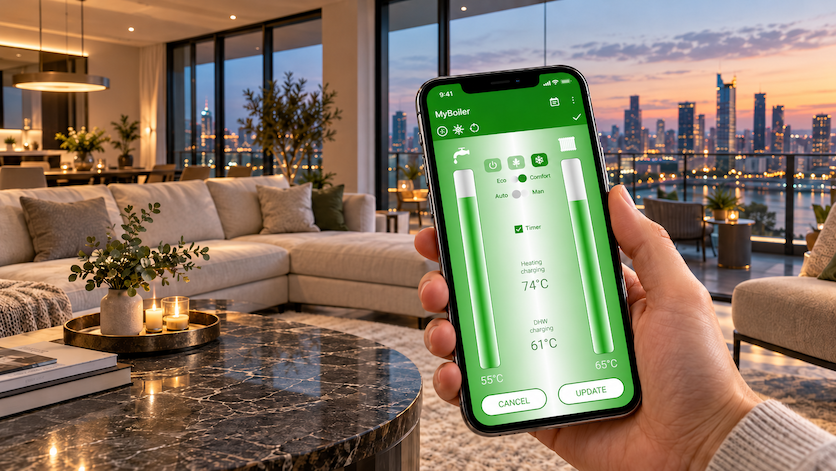
With the ECBC range of smart electric combi boilers and the MyBoiler App, property owners can remotely adjust heating and hot water temperatures, configure operating modes, manage heating schedules and check their boiler’s operating status.
Let’s explore how this technology can help different types of rental properties.
Imagine you manage three holiday apartments.
Your guests check out on Sunday morning, and the next bookings don’t arrive until Friday.
During those five days, the properties are unoccupied. Yet if the heating schedules haven’t been adjusted, their boilers could continue operating as though guests were still staying there.
The same situation can occur when guests leave the property for the day without reducing the heating.
Electric heating consumes electricity when it is actively producing heat. The longer the system operates, and the greater the heating demand, the more electricity it can use.
This doesn’t mean a boiler consumes its maximum rated power continuously. Actual consumption depends on factors including heat demand, insulation, outdoor temperature, controls and operating time.
However, unnecessary heating periods can contribute to avoidable costs.
The key isn’t to sacrifice comfort. It’s to make sure heating is available when it’s needed, rather than leaving the same settings running regardless of occupancy.
That’s where remote boiler management can make a difference.
A smart electric combi boiler combines electric central heating and domestic hot water production with connected controls that allow compatible boiler functions to be managed remotely.
Unlike a conventional boiler that may require adjustments directly from its control panel, an ECBC smart electric boiler can be connected to the property’s broadband network and controlled through the MyBoiler App.
Available for Apple and Android devices, the app gives authorised users access to a range of operating settings from their smartphone or tablet.
This is particularly useful for landlords, letting agents and property managers who aren’t always physically present at their properties.
ECBC’s compatible smart electric boilers offer the following functions:
1. Heating temperature
Adjust the boiler’s central heating water temperature to suit the property’s heating requirements.
2. Domestic hot water temperature
Manage the boiler’s hot water temperature settings without visiting the property.
3. Standby and operating controls
Place compatible boilers into standby or adjust their operating status when appropriate, subject to the property’s heating, hot water and frost-protection requirements.
4. Summer and Winter modes
Switch between operating modes depending on the property’s requirements.
5. ECO and COMFORT hot water modes
For compatible ECBC models, ECO and COMFORT modes provide different approaches to hot water operation.
On suitable models with internal storage, ECO mode uses stored hot water with a recovery period, while COMFORT mode prioritises hot water availability.
The most suitable setting depends on the boiler model and guests’ hot water usage.
6. Seven-day heating programmes
Create weekly heating schedules to match expected occupancy and heating requirements.
7. Boiler status and diagnostic information
Check operating information and review boiler logs for recorded warnings, errors or anomalies.
This can help property managers identify potential issues and arrange technical support before the next guest arrives.
Available functions depend on the selected boiler model, connectivity and app compatibility.
Airbnb and short-term rental properties often experience frequent changes in occupancy.
One day, the property may be fully occupied. The next, it could be empty.
For landlords paying the utility bills, maintaining identical heating settings throughout these changing circumstances may lead to unnecessary consumption.
With a compatible ECBC smart electric combi boiler, the heating can be managed around the property’s booking schedule.
A property manager can use the MyBoiler App to adjust the heating settings before check-in.
For example, if guests are expected in the afternoon, the manager can arrange for the heating to operate beforehand, allowing sufficient time for the accommodation to reach a comfortable temperature.
There is no need to maintain full occupied temperatures throughout a lengthy vacancy simply to ensure the property feels comfortable on arrival.
Guests should have access to adequate heating and hot water throughout their booking.
The property’s heating programme can be configured to provide sensible baseline operation while allowing appropriate temperature adjustments for comfort.
The boiler’s domestic hot water settings can also be managed within safe operating limits.
Once guests leave and the property is confirmed unoccupied, the manager can adjust the boiler’s heating programme remotely.
Depending on the season, property construction and weather conditions, this could mean reducing the heating demand or switching to an appropriate setback or standby arrangement.
Importantly, frost protection and any necessary moisture-control heating must still be maintained.
The advantage is flexibility: the heating system can follow the property’s actual occupancy rather than remaining on an unchanged schedule.
Holiday homes present a slightly different challenge.
Unlike short-term rental apartments, some holiday homes may remain empty for several weeks or months.
This means owners need a heating system that is convenient to manage from another location.
A smart electric boiler allows them to check and adjust compatible settings remotely, provided the property has a functioning broadband connection and electricity supply.
For example, an owner could reduce normal heating operation during a period of vacancy and adjust the settings ahead of a planned visit.
This is particularly useful during colder months, although reducing or disabling normal heating must never compromise the property’s frost-protection requirements.
In buildings vulnerable to freezing temperatures, damp or condensation, maintaining suitable background heating may be necessary.
Remote control provides convenience, but it doesn’t replace appropriate property protection.
Houses in Multiple Occupation (HMOs) can be challenging to manage because several unrelated occupants may share heating and hot water facilities.
Where utility bills are included in the rent, the landlord or management company often carries the financial responsibility for the energy consumed.
A smart electric boiler can offer useful management features, particularly where heating is provided through a shared central heating installation.
A seven-day heating programme can help establish regular heating periods appropriate to the occupants’ needs.
However, unlike an empty holiday let, an HMO is someone’s home.
Tenants must have adequate heating and hot water, and the heating arrangements must comply with applicable housing standards, tenancy obligations and local authority requirements.
Smart boiler controls should therefore be used to support effective heating management, not to restrict occupants’ reasonable access to essential services.
For HMO landlords, another useful feature is the ability to review boiler operating information and recorded errors.
If the boiler identifies a fault or abnormal operating condition, the available diagnostic history may help a qualified engineer investigate the issue.
This can be particularly valuable where a property houses several occupants who depend on a shared heating and hot water system.
When specifying an electric combi boiler for an HMO, the number of occupants and simultaneous hot water requirements are critical.
A property with multiple showers being used at the same time may require a different solution from a small shared house with a single bathroom.
Electrical supply capacity, peak heating demand, incoming mains water conditions and the number of outlets must also be considered.
Smart controls improve the management of a suitable heating system. They do not compensate for an undersized boiler.
Potentially, yes.
But it’s important to understand how the savings may occur.
A smart electric boiler does not inherently generate more heat from each unit of electricity simply because it has Wi-Fi connectivity.
Instead, connected controls can help reduce unnecessary energy use by allowing owners to manage how and when heating operates.
For example:
The financial benefit depends on the building’s heat demand, occupancy patterns, electricity tariff and how the system was previously controlled.
A property already using effective thermostats and heating programmes may see less benefit than one operating on poorly managed schedules.
The principal advantage is greater control over heating operation.
Consider an electric heating system consuming an average of 3kW while actively heating.
If suitable scheduling reduces unnecessary active heating by two hours per day:
3kW × 2 hours = 6kWh of electricity avoided per day.
At an illustrative electricity unit rate of 25p/kWh, that represents £1.50 per day, or £45 across 30 days.
This is a hypothetical calculation, not a guaranteed saving or measured ECBC performance result.
Actual savings depend on the amount of heating genuinely avoided. Electricity standing charges and other costs are not included.
The example demonstrates why managing unnecessary heating periods can matter, particularly across a portfolio of rental properties.
Artificial intelligence and smart-home technology are increasingly being used to improve property management.
Depending on the platform, connected systems can assist with occupancy management, energy monitoring, maintenance planning and automated property operations.
However, not all smart heating systems use artificial intelligence.
The ECBC MyBoiler App provides connected boiler controls, programmable heating schedules and diagnostic information. These features should not be confused with AI-based occupancy prediction or automatic energy optimisation.
For landlords, reliable remote control and practical scheduling can already provide valuable operational benefits without requiring a complex automated building-management system.
ECBC offers a range of smart electric boilers designed for different heating and domestic hot water requirements.
The correct model depends on the size of the property, available electrical supply and the number of people likely to use hot water simultaneously.
For example, properties with baths or greater hot water storage requirements may benefit from an ECBC model incorporating an internal hot water cylinder.
Properties with shower-only configurations may be suited to an instantaneous electric combi boiler, provided its flow rate and temperature-rise performance match the expected demand.
For larger properties or HMOs, a full assessment of the space heating load, peak hot water demand and electrical infrastructure is particularly important.
When selecting a boiler, landlords and property managers should consider:
A qualified installer should assess these requirements before a final boiler selection is made.
Explore ECBC Smart Electric Combi Boilers
The MyBoiler App allows users of compatible ECBC electric boilers to manage supported boiler settings from a smartphone or tablet.
The app is available for both Apple iOS and Android.
Download MyBoiler for iPhone and iPad
The boiler must be correctly connected and configured for remote operation. Reliable broadband connectivity at the property is essential.
Yes. ECBC smart electric boilers compatible with the MyBoiler App allow remote access to supported heating, hot water and operating settings, provided the appliance is correctly configured and connected to the internet.
Yes. The heating programme or operating settings can be adjusted remotely, provided minimum temperature, frost-protection and property maintenance requirements are maintained.
Compatible models allow the domestic hot water temperature setting to be adjusted. Temperature settings must remain appropriate for safe hot water delivery and any relevant stored-water hygiene requirements.
Yes. Compatible ECBC smart boilers have a built-in seven-day heating programme that can be managed through the supported control interface.
Potentially. Suitability depends on heat loss, occupancy, hot water demand, electrical capacity and applicable housing standards. Occupants’ rights to adequate heating and hot water must always be maintained.
The standard functions described here do not include automatic guest detection or booking-platform integration. Heating programmes and settings are configured by the user.
Not automatically. Potential savings come from reducing unnecessary heating and managing operating settings more effectively. Actual results depend on the property and how the system is used.
The MyBoiler App provides access to boiler information and recorded errors or anomalies on compatible models. Remote diagnostic information can help identify potential problems but does not replace professional servicing or fault diagnosis.
Whether you manage a single holiday cottage or a portfolio of rental apartments, keeping control of heating and hot water is an important part of managing property operating costs.
A smart electric boiler offers a practical way to adjust heating schedules, manage domestic hot water settings and review boiler information without repeatedly travelling to the property.
For Airbnb hosts, short-term rental operators and holiday-home owners, this can make periods between bookings easier to manage.
For HMO landlords, it provides additional visibility and control while supporting the need to maintain reliable heating and hot water for occupants.
The objective is simple: provide comfortable accommodation while reducing unnecessary heating operation and giving property managers greater control over their systems.
Discover how an ECBC smart electric combi boiler could fit your property.