


blog
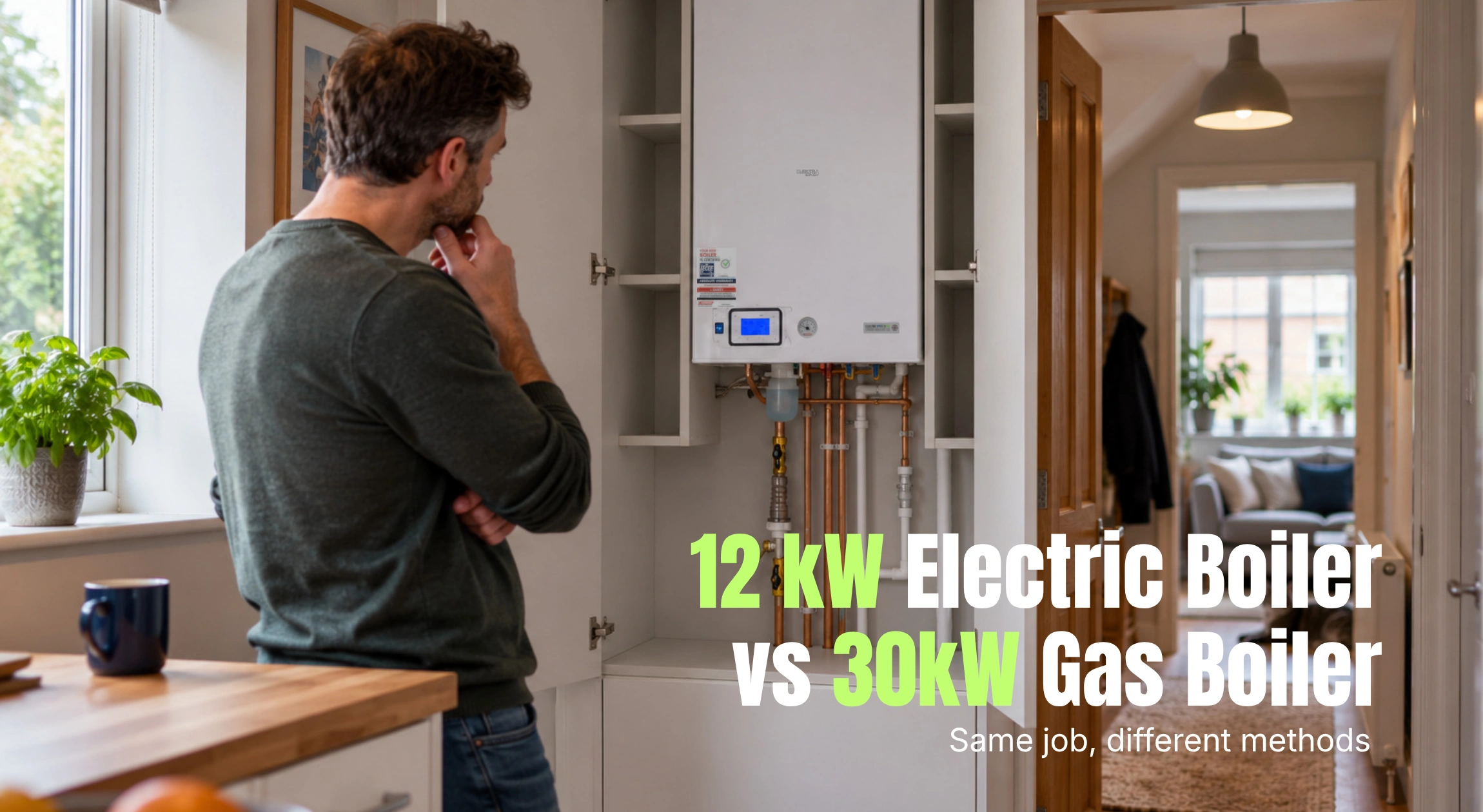
We hear it most weeks, and it’s a fair reaction. If you’re replacing a 28kW or 30kW gas combi, a boiler with less than half the rating looks like a downgrade.
It isn’t necessarily. A 12kW electric boiler is not a 30kW boiler in disguise. It reaches the same result by a different route, and most of that difference comes down to what happens when you turn the shower on.
For a suitably sized 2 to 3 bedroom home, the Elektra Smart.BPC can do the job you’d normally hand to a 28-30kW gas combi. It does it by holding hot water in a cylinder and heating as you use it, not by producing 30kW. Whether it fits your home comes down to three things: heat loss, how you use hot water, and your mains flow and pressure.
In this article: The graph | Filling a bath | Two showers | Your mains | Sizing
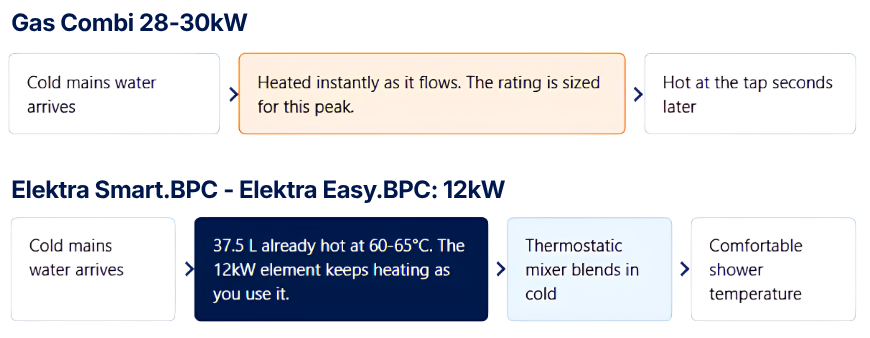
Both boilers get hot water to your shower. They get there differently.
Heating is separate. What your radiators need comes from your home’s heat loss, not from the rating of the old boiler.
No, and the number on the old boiler tells you very little about it.
What a house needs for heating comes from its heat loss: how quickly warmth escapes through the walls, windows, roof, floor and ventilation on a cold day. A modern, well-insulated mid-terrace and a solid-walled Victorian detached can both have three bedrooms and need very different amounts of heat. Proper sizing starts with the property. Copying whatever is printed on the boiler you’re removing is how people end up with a 30kW boiler in a house that needs a fraction of that.
Hot water.
Open the shower on a gas combi and cold mains water goes in one side. A few seconds later it has to come out hot, while it’s still moving. There’s no cylinder and no reserve. Doing that at a decent flow takes a lot of power in a very short time, so a modest home can end up with a 28 or 30kW boiler. Much of that rating is there for the taps, not the radiators.
It carries a 37.5-litre cylinder inside the boiler, kept at 60-65°C. When the shower goes on, hot water is already waiting, and the boiler keeps heating the incoming water while you use it. Nobody showers at 60°C, so a thermostatic mixer blends the stored water with cold. That’s why 37.5 litres of hot water turns into a good deal more litres of shower.
A typical shower running at around 9 litres per minute uses between 45 and 72 litres of mixed water over 5 to 8 minutes. But that doesn’t mean you need 45 to 72 litres of stored hot water. With the cylinder at around 60°C, incoming mains water at approximately 14°C, and the shower mixer set to a comfortable 38–40°C, only around 52–57% of the shower water needs to come from the hot supply.
As the graph shows, a 5-minute shower needs roughly 24–25 litres of hot water at 60°C, while an 8-minute shower requires around 38–41 litres. The Smart.BPC has a 37.5-litre cylinder, so the stored hot water alone represents considerably more usable shower water once mixed down to shower temperature.
In ECO mode, this stored volume is designed around a normal 5 to 8 minute shower. And importantly, the boiler doesn’t simply wait for the cylinder to empty.
In COMFORT mode, the system goes a step further, maintaining the hot-water store for on-demand delivery. That’s why describing the supply simply as “37.5 litres of hot water” can be misleading. What matters at the shower is the amount of mixed water at 38–40°C that the stored energy can provide, together with the boiler’s ability to keep heating as you use it.
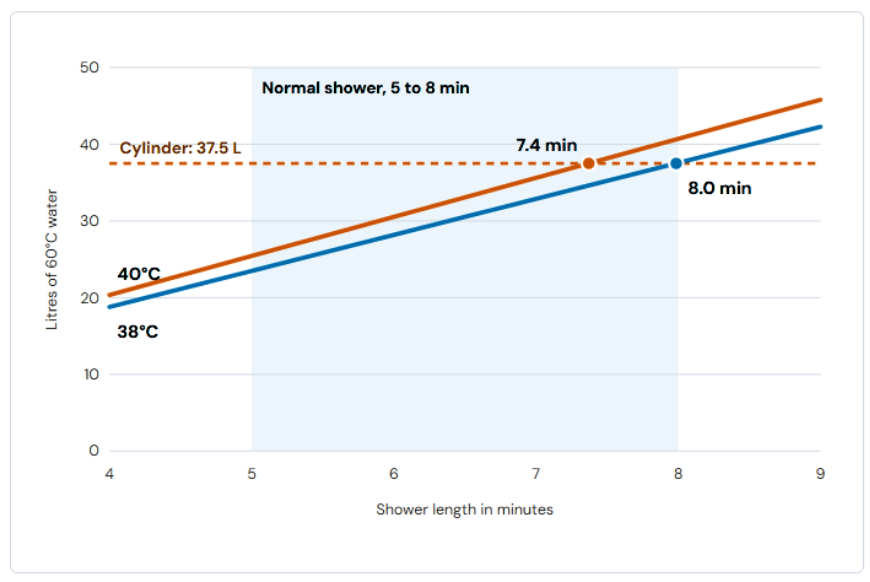
So, to anwer the question, a normal shower will not necessarily drain the Smart.BPC cylinder.
The Smart.BPC stores 37.5 litres at 60°C, so a typical shower can use a significant proportion of the stored volume, but the boiler, when in COMFORT Mode is also heating water while the shower is running. This means the cylinder does not simply empty litre for litre as you shower.
In practice, a normal 5 to 8 minute shower is within the intended operating range. Longer showers, higher flow rates, or a hotter mixer setting will use the stored hot water faster.
ECBC publishes a hot water output curve for the Smart.BPC. We’ve included the part that doesn’t flatter us.
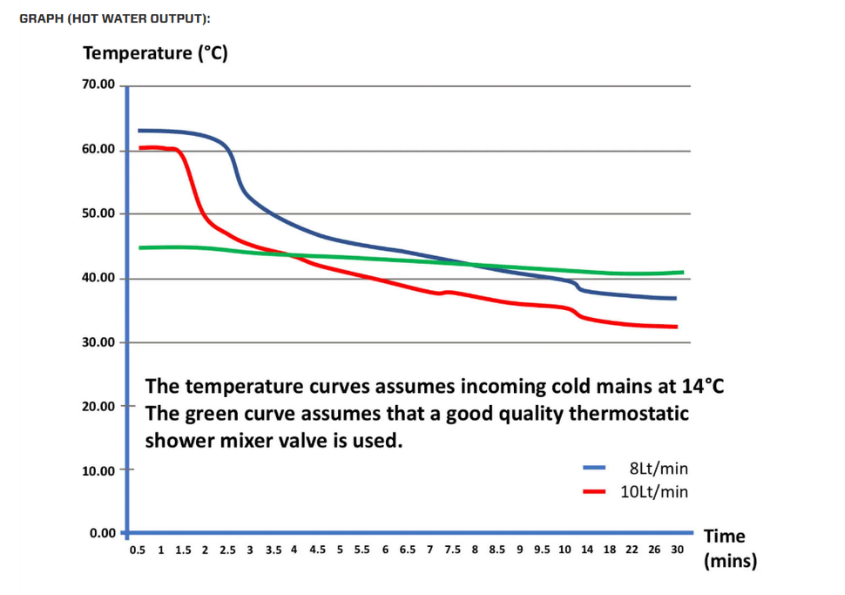
That’s the honest picture. The store buys you the first few minutes at high temperature. After that the element does the work, and 12kW is a fixed amount of heat. Push more litres per minute through it and each litre gets less. Physics, not a design flaw, and it’s the reason the flow rate matters more than the kW figure.
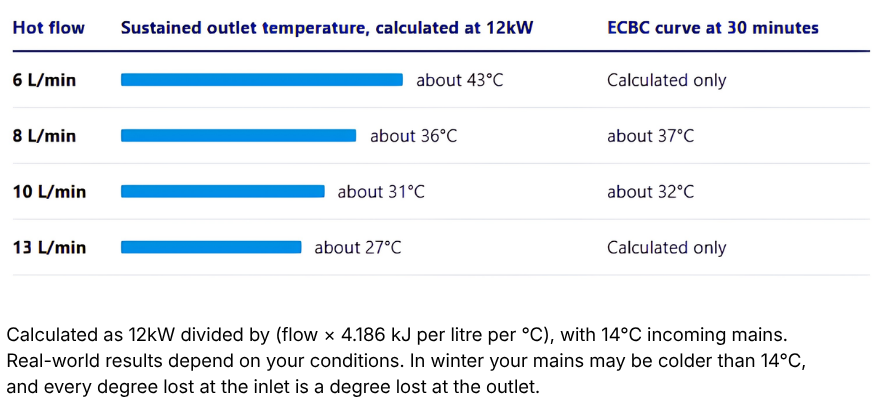
Worth noticing what the table implies. A shower rarely runs on 8 litres per minute of hot water. The mixer adds cold, so the hot draw is smaller, and a smaller hot draw means a hotter result from the same 12kW. That’s why a good thermostatic mixer keeps getting recommended.
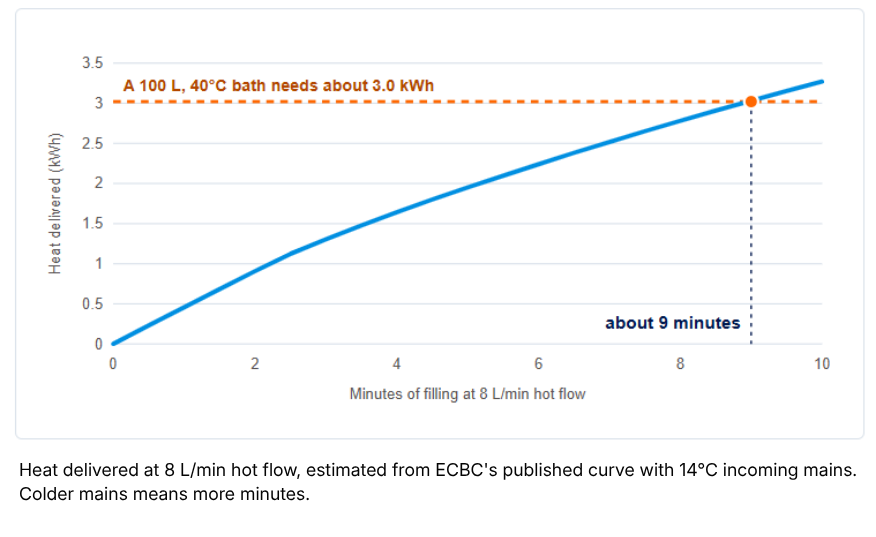
A bath is the harsh test, because you’re asking for a lot of hot water in a short time. The traditional sizing example, from BS 6700 (since withdrawn and replaced by BS EN 806 and BS 8558), is a standard 1700 x 700mm bath: about 100 litres at 40°C, made up of roughly 60% hot water and 40% cold.
For bath filling, the Smart.BPC is set to 8 litres per minute. Slowing the flow looks odd until you remember the trade-off from the graph. Less flow gives the boiler more time to put heat into each litre, so the water arrives hotter. What matters is how quickly you get the amount of water you need at the temperature you need, and litres per minute is only half of that.
Heating 100 litres from 14°C to 40°C takes about 3kWh. Reading the 8 litre curve, the boiler has delivered that much heat after about nine minutes.
Not sure your home fits?
Send us your mains flow reading (test below) and a photo of your consumer unit, and we’ll tell you whether 12kW works for you.
With 2 bar of cold mains pressure at the boiler, two thermostatic showers can run at once, each drawing around 4 litres per minute of hot water. Once the mixers add cold, each shower’s flow rises to 6 to 8 litres per minute. This is the point where a good thermostatic mixer stops being a nice extra and becomes part of the specification.
Often, yes. This is the one people miss.
Imagine a gas combi that can heat enough water for 12 litres per minute under the right conditions. Now measure what’s actually arriving at your house, and it’s 9 litres per minute. The boiler can’t invent the missing 3. A bigger boiler only helps if there’s water to heat.
The bucket test
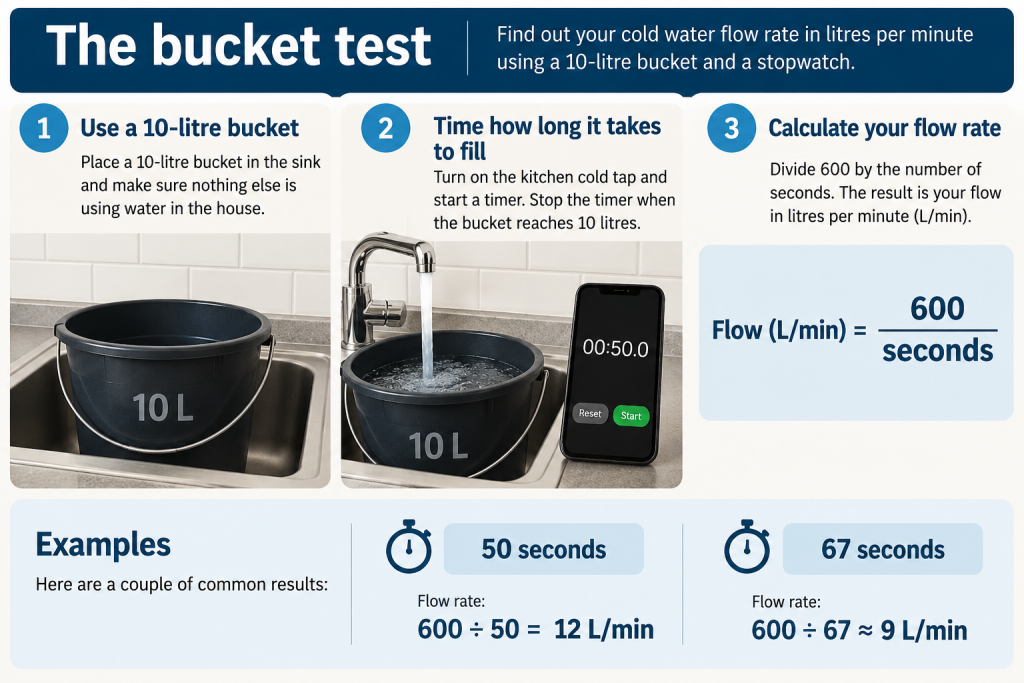
Time how long the kitchen cold tap takes to fill a 10-litre bucket, with nothing else running. Divide 600 by the number of seconds and you have your flow in litres per minute. Fifty seconds means 12. Sixty-seven means about 9.
Pressure matters too. Cold mains at the Smart.BPC should not exceed 2 bar. Above that, a pressure-reducing valve set between 1.5 and 2.0 bar is recommended, and/or a 2-litre potable expansion vessel. These are installation details, and they decide whether you get the performance you were shown.
No, and we’d be wary of any sizing guide built on bedroom count alone. Three things change the answer:
Then there’s the electrical supply. At full power, 12kW is roughly 52A at 230V. The element starts at about 2kW and ramps up, but the supply still has to be checked before anyone orders anything. Sometimes 12kW is right. Sometimes it isn’t. Size the boiler to the home, not to the number on the one you’re taking out.
Performance figures are based on ECBC test data for the Elektra Smart.BPC with 14°C incoming cold mains. Colder mains, lower pressure or higher flow rates reduce delivered temperature. The bath example uses the traditional sizing figure of 100 litres at 40°C from BS 6700, which has since been withdrawn.

 Electric Combi Boilers Company
Green Acres
Oakley Green Road
Windsor, SL4 4QF
 contact@electriccombiboilers.uk
 Call 020 8998 2024
Mon - Fri: 9 am - 5 pm
Sat - Sun: Closed
